
Archive for 2013
Sri Harmandir Sahib, Sri Amritsar - Golden Temple Amritsar
The Harmandir Sahib (ਹਰਿਮੰਦਰ ਸਾਹਿਬ) or Darbar Sahib (ਦਰਬਾਰ ਸਾਹਿਬ ), informally referred to as The Golden Temple, is culturally the most significant shrine of the Sikhs and one of the oldest Sikh Gurudwara. It is located in the city of Amritsar, which was established by Guru Ram Das, the fourth guru of the Sikhs and is known as "guru di nagri" meaning city of the Sikh Guru.
|
Introduction
The Harmandir Sahib is considered holy by Sikhs because the eternal Guru of Sikhism, the Sri Guru Granth Sahib, is always present inside in it and its construction was mainly intended to build a place of worship for men and women from all walks of life and all religion to come and worship God equally. The Sri Guru Granth Sahib is the holiest literature in the Sikh religion, the tenth Guru of Sikhism, Guru Gobind Singh on 7th October 1708 at Nanded made it the eternal Sikh Guru and the leader of Sikhism. Anywhere in the world where the Guru Granth Sahib is present is equally holy and precious to Sikhs. Amritsar is the location of Harmandir Sahib.
|
History
Its name literally meaning, House of God. The fourth Guru of Sikhism, [Guru Ram Das], excavated a tank in 1577 AD which subsequently became known as Amritsar (meaning: Pool of the Nectar of Immortality, giving its name to the city that grew around it. In due course, a splendid Sikh edifice, Harmandir Sahib rose in the middle of this tank and became the supreme centre of Sikhism. Its sanctum came to house the Adi Granth comprising compositions of Sikhi Gurus and other saints considered to have Sikh values and philosophies e.g. Baba Farid, Kabir, etc. The compilation of the Adi Granth was started by the fifth Guru of Sikhism, Guru Arjan Dev Ji.
|
| Originally built during 1574 AD, the site of the temple was surrounded by a small lake in a thin forest. The third of the six grand Mughals, emperor Akbar, who visited the third Sikh Guru, Guru Amar Das, at the neighbouring town of Goindval was so impressed by the way of life in the town that he gave a jagir (the land and the revenues of several villages in the vicinity) to the Guru's daughter Bhani as a gift on her marriage to Bhai Jetha, who later became the fourth Sikh Guru, Guru Ram Das. Guru Ram Das enlarged the lake and built a small township around it. The town was named after Guru Ram Das as "Guru Ka Chak", "Chak Ram Das" or "Ram Das Pura". |
The Harmandir Sahib Complex and areas in its vicinity
|
| The temple is surrounded by a large lake of water, known as the Sarovar which consists of Amrit (Holy Water or Immortal Nectar). There are four entrances to the temple, signifying the importance of acceptance and openness; ostensibly, this concept is reminiscent of the tent of Abraham in the Old Testament -- his tent was open on all four sides in order to be able to welcome travelers from all directions. Inside the temple complex there are many shrines to past Sikh Gurus, Saints and martyrs (see map). There are three holy trees (Bers) each signifiying a historical event or Sikh saint. Inside the temple there many memorial plaques that commemorate past Sikh historical events, saints, martyrs and includes commemorative inscriptions of all the Sikh soldiers who died fighting in World wars one and two. For a new visitor the first recommended place to visit is the information Office highlighted in the map and followed by visiting the Sikh Central museum near the main entrance and clock tower. Anyone who wants to enter the Harmandir Sahib may do so, irrespective of religion, colour, creed or sex. The only restrictions are that the person must not drink alcohol, eat meat or smoke cigarettes or other drugs while in the shrine. Visitors are, as well, expected to dress appropriately and everyone must cover their heads as a sign of respect, remove their shoes and wash their feet in the small pool of water as they enter the Harmandir Sahib premises. Head scarves are provided. All Sikh temples (Gurdwaras) in the world follow this traditional rule that everyone is welcome to enter. There are four doors to get into the Harmandir Sahib, meaning that Harmandir sahib is open to anyone. |
The Amritsar area
|
| Amritsar is located in the Majha region of the Punjab. Majha is also known as the Bari Doab, since it is the Doab (Do = two, ab = rivers) or the (fluvial) tract of land which lies between two of the five great rivers of the province, the Ravi and the Beas. As such, Majha lies in the heart of the ancient Punjab region, comprised of Gurdaspur, Batala and Tarn Taran Sahib as well as Amritsar. |
Gurudwara Bangla Sahib - Golden Temple Amritsar
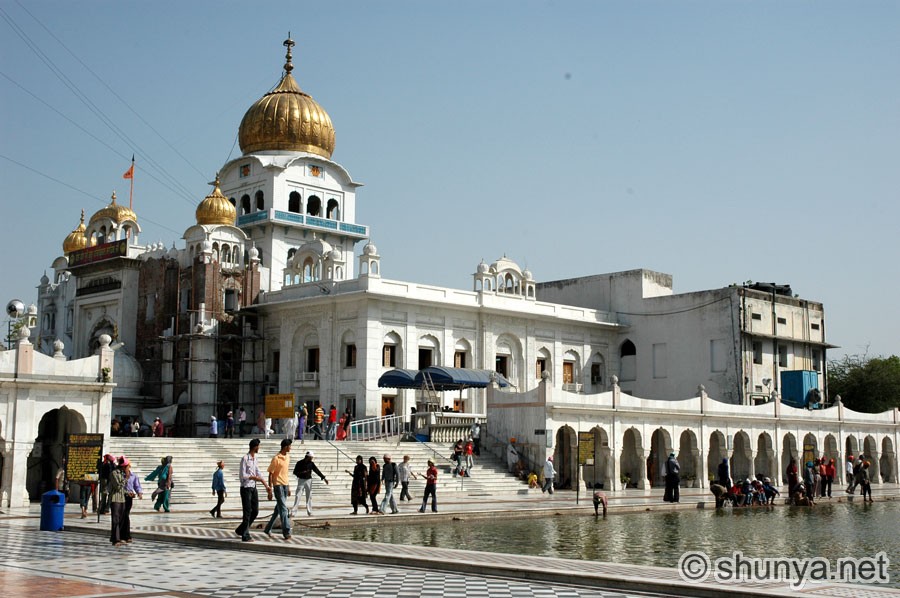
Gurudwara Bangla Sahib is the most prominent Sikh Gurdwara, or Sikh house of worship, in Delhi, known for its association with the eighth Sikh Guru, Guru Har Krishan Sahib ji, and the pond inside its complex, known as the "Sarovar", whose water is considered holy by Sikhs and is known as "Amrit". It was built by Sikh General, Sardar Bhagel Singh in 1783, who supervised the construction of nine Sikh shrines in Delhi in the same year, during the reign of Mughal Emperor, Shah Alam II.
It is situated in the Connaught Place, New Delhi area and is instantly recognisable by its stunning golden dome and tall flagpole, Nishan Sahib.
History
Gurdwara Bangla Sahib was originally a bungalow belonging to Raja Jai Singh, an Indian ruler in the seventeenth century, and was known as Jaisinghpura Palace.
The eighth Sikh Guru, Guru Har Krishan Sahib ji resided here during his stay in Delhi in 1664. During that time, there was a smallpox and cholera epidemic, and Guru Har Krishan Sahib ji helped the suffering by giving aid and fresh water from the well at this house. Soon he too contracted the illness and eventually died on March 30, 1664. A small tank was later constructed by Raja Jai Singh over the well, its water is now revered as having healing properties and is taken by Sikhs throughout the world back to their homes.
The Gurdwara and its Sarovar are now a place of pilgrimage for both Sikhs and Hindus, and a place for special congregation on birth anniversary of Guru Har Krishan Sahib ji and death anniversary of Maharaja Ranjit Singh.
NEW 2013 Live link to Golden Temple Amritsar - Golden Temple Amritsar
Live Kirtan from Golden Temple(Harmandir Sahib) Darbar Sahib-SGPC Amritsar
Check This Link : http://gurbani.co/kirtan_gt.php
Jallianwala Bagh - Golden Temple Amritsar
 Is a peaceful park with picnicking families and college kids, but move to a section of the wall which still has visible bullet marks, and you will be reminded of one of the most horrific events in colonial Indian history. When the Rowlatt Act (1919), which gave the British the power to arrest and imprison Indians without a trial if suspected of sedition, was imposed on Indians it was severely criticised and regular hartals (strikes) were organised to protest the law.
Then Lieutenant Governor of Punjab, Sir Michael O' Dwyer, arrested an Indian leader causing great unrest among the people. On April 13,1919 (also the festival of Baisakhi) around 10,000 people gathered at the Jallianwala Bagh to peacefully protest the new law. General Dyer had been called to Amritsar to return the city to order.
He arrived at the Bagh with 150-armed soldiers, ordered the crowd to scatter and two minutes later inhumanly commanded his troops to open fire. The square was surrounded by high walls and the soldiers had blocked the only entrance (and exit) to the compound. The firing (1650 rounds) continued for about 15 minutes and people were shot as they tried to jump the wall while others drowned after they jumped into the well to escape the relentless onslaught of bullets, most of which found their mark.
Jallianwala Bagh is situated at a stones throw from The Golden Temple. It is a witness of the disaster called Jallianwala Bagh slaughter. As the history goes, during the time of independence struggle, when Mangal Pandeypropel the bugle for beginning the struggle for independence, General Dyer made a rule that no Indian will be allowed to hold assembly or processions.
On 13 April 1919, Baisakhi Day, thousands of Punjabis meet from nearby places to celebrate the festival. As the communication system was underdeveloped at that time, they were not informed about this rule. Thinking it as a destruction of the law, General Dyer entered in the Park with his troops and open excited on all the innocent men women and children present there.
Jallianwala Bagh has a unique importance attached to it with respect to India's Freedom great effort. It was at this historic park that hundreds of men, women and children sacrificed their lives in front of the cruel firing of the British forces. Nowadays Jallianwala Bagh has been turned into a large and well-laid park and is a major tourist attraction.
We present you, leisure tour, business tour and pilgrimage tour. Travel to Amritsar with About Golden Temple and have a unforgettable experience of staying in best hotels in Amritsar along with a visit to nearby spiritual places including Golden Temple. You must visit historical places like Jallianwala Bagh and Ram Bagh etc. We enhance your knowledge regarding Jallianwala Bagh and presents online trip of Amritsar Punjab, India.
About 400 people (including children) died while 1500 were left wounded. Though there was an international outcry over this horrific uncalled-for massacre neither Dyer nor O'Dwyer was ever charged with any crime. In response to this massacre, Nobel laureate Rabindranath Tagore returned his knighthood and Gandhi began his program of civil disobedience announcing that 'co-operation in any shape or form with this satanic government is sinful'.
In 1997 Queen Elizabeth II visited Jallianwala Bagh and though she laid a wreath on the memorial to the victims no official apology was made.
Jallianwala Bagh is a five-minute walk from the Golden Temple. The stone well has been preserved as a monument to the victims (120 bodies were recovered from the well) and the "flame of liberty," a 45 foot flame-shaped red sandstone pillar set in a pool, was built in 1961 as a memorial. The park is open from 6 am to 7 pm in summer and 7 am to 6 pm in winter. The Martyr's Gallery which features portraits of heroes involved in the incident, is open from 9 am to 5 pm in summer and 10 am to 4 pm in winter.
A spectrum of Left groups, as well as radical elements in the Congress, were to lay claim to the heritage of the 1919 uprising. Today, as the Shiromani Akali Dal-Bharatiya Janata Party alliance seeks to appropriate the legacies of Shaheed Udham Singh and Bhagat Singh, reclaiming the real meaning of that struggle has never been more important.
The following exchange took place at the Hunter Committee hearings:
 Excuse me putting it that way, General, but was it not a resort to what has been called "frightfulness" for the benefit of the Punjab district (sic.) as a whole?
I don't think so. I think it was a horrible duty for me to perform. It was a merciful act that I had given them the chance to disperse (that is, in the morning). The responsibility was very great. I had to make up my mind that if I fired, I must fire well and strong so that it would have its full effect.
And you did not open fire with the machine guns simply by the accident of the armoured cars not being able to get in?
I have answered you. I have said that if they had been there, the possibility is that I would have opened fire with them.
You had no information that even a single individual of the mob had a firearm?
No, they were going to do it with lathis. I know there were thousands of lathis in the railway station and they were going to be their arms.
On 13 April 1919, Baisakhi Day, thousands of Punjabis meet from nearby places to celebrate the festival. As the communication system was underdeveloped at that time, they were not informed about this rule. Thinking it as a destruction of the law, General Dyer entered in the Park with his troops and open excited on all the innocent men women and children present there.
Jallianwala Bagh has a unique importance attached to it with respect to India's Freedom great effort. It was at this historic park that hundreds of men, women and children sacrificed their lives in front of the cruel firing of the British forces. Nowadays Jallianwala Bagh has been turned into a large and well-laid park and is a major tourist attraction.
We present you, leisure tour, business tour and pilgrimage tour. Travel to Amritsar with About Golden Temple and have a unforgettable experience of staying in best hotels in Amritsar along with a visit to nearby spiritual places including Golden Temple. You must visit historical places like Jallianwala Bagh and Ram Bagh etc. We enhance your knowledge regarding Jallianwala Bagh and presents online trip of Amritsar Punjab, India.
About 400 people (including children) died while 1500 were left wounded. Though there was an international outcry over this horrific uncalled-for massacre neither Dyer nor O'Dwyer was ever charged with any crime. In response to this massacre, Nobel laureate Rabindranath Tagore returned his knighthood and Gandhi began his program of civil disobedience announcing that 'co-operation in any shape or form with this satanic government is sinful'.
In 1997 Queen Elizabeth II visited Jallianwala Bagh and though she laid a wreath on the memorial to the victims no official apology was made.
Jallianwala Bagh is a five-minute walk from the Golden Temple. The stone well has been preserved as a monument to the victims (120 bodies were recovered from the well) and the "flame of liberty," a 45 foot flame-shaped red sandstone pillar set in a pool, was built in 1961 as a memorial. The park is open from 6 am to 7 pm in summer and 7 am to 6 pm in winter. The Martyr's Gallery which features portraits of heroes involved in the incident, is open from 9 am to 5 pm in summer and 10 am to 4 pm in winter.
A spectrum of Left groups, as well as radical elements in the Congress, were to lay claim to the heritage of the 1919 uprising. Today, as the Shiromani Akali Dal-Bharatiya Janata Party alliance seeks to appropriate the legacies of Shaheed Udham Singh and Bhagat Singh, reclaiming the real meaning of that struggle has never been more important.
The following exchange took place at the Hunter Committee hearings:
Excuse me putting it that way, General, but was it not a resort to what has been called "frightfulness" for the benefit of the Punjab district (sic.) as a whole?I don't think so. I think it was a horrible duty for me to perform. It was a merciful act that I had given them the chance to disperse (that is, in the morning). The responsibility was very great. I had to make up my mind that if I fired, I must fire well and strong so that it would have its full effect.
And you did not open fire with the machine guns simply by the accident of the armoured cars not being able to get in?
I have answered you. I have said that if they had been there, the possibility is that I would have opened fire with them.
You had no information that even a single individual of the mob had a firearm?
No, they were going to do it with lathis. I know there were thousands of lathis in the railway station and they were going to be their arms.
Art Gallery at Sheesh Mahal - Golden Temple Amritsar
Art Gallery at Sheesh Mahal - Golden Temple Amritsar
Art Gallery at Sheesh Mahal
 Patiala, contains a rare set of miniature paintings and paintings in Kangra, Rajasthan and Patiala styles, special section on Tibetan Arts and Artifacts etc. and its Medal Gallery contains the world's major group of Medals and decorations.
Others depict themes from mythology, legends, Raga Ragnis, Nayak-Nayika and Baramasa. The placement of concave and coloured mirrors in the prayer room creates an remarkable effect on the mind when a luminosity is put there. The floral designs on the walls are reminiscent of Emperor Jahangir's time.
Art Gallery at Sheesh Mahal
Patiala, contains a rare set of miniature paintings and paintings in Kangra, Rajasthan and Patiala styles, special section on Tibetan Arts and Artifacts etc. and its Medal Gallery contains the world's major group of Medals and decorations.Others depict themes from mythology, legends, Raga Ragnis, Nayak-Nayika and Baramasa. The placement of concave and coloured mirrors in the prayer room creates an remarkable effect on the mind when a luminosity is put there. The floral designs on the walls are reminiscent of Emperor Jahangir's time.
Shahpur Kandi Fort - Golden Temple Amritsar
Shahpur Kandi Fort (7 Km from Pathankot)
 Shahpur Kandi Fort, 7 Km from Pathankot: This 16th century fort nestles at the foot of the towering Himalayas and overlooks the river Ravi. Is a comfortable rest-house now.
It was built in 16th century by Bhao Singh, who named it after the Emperor Shah Jahan. The little town of Shahpur is located on the left bank of the Ravi River. The fort now functions as a rest house.
Some Muslim Tombs and a mosque are sighted near the fort. There is a typical old stone tank just outside the village.
Shahpur Kandi Fort, 7 Km from Pathankot: This 16th century fort nestles at the foot of the towering Himalayas and overlooks the river Ravi. Is a comfortable rest-house now.It was built in 16th century by Bhao Singh, who named it after the Emperor Shah Jahan. The little town of Shahpur is located on the left bank of the Ravi River. The fort now functions as a rest house.
Some Muslim Tombs and a mosque are sighted near the fort. There is a typical old stone tank just outside the village.
The Sheesh Mahal - Golden Temple Amritsar
 It was built in the reign of Maharaja Narinder Singh (1845-1862) in a forest with terraces, gardens, fountains and an artificial lake. With two watching towers in the north and the south the lake is connected to Banasar Ghar, where all type of stuffed animals are kept and Sheesh Mahal, the residential palace with a suspension bridge which is a copy of theLakhsman Jhula at Rishikesh.
Part of the three storied building is inset with pieces of reflecting mirrors and a large number of wall paintings depicting scenes from Bhagwat Puran and portraits of the Sikh Gurus. The palace has galleries displaying antique paintings, bronzes, sculptures and portraits of the Maharajas of Patiala. The highlight is the gallery which displays the world's largest collection of medals, decoration and orders of various countries.
Punjab state, the smiling spirit of India has been appropriately nicknamed the city of gardens and palaces. The majestic palaces of Punjab accentuate the beauty of the tedious farmlands and majestic temples. Sheesh Mahal is one such beautiful palace in Patiala that flaunts the colorful splendor of the erstwhile maharajahs.
Sheesh Mahal built under the kind patronage of the former Maharaja of Patiala, Narendra Singh, a devotee of beauty, in the year 1847; the rambling three-storied Sheesh Mahal is a fine merge of the modern Occidental and the customary Mughal architecture.
The Sheesh Mahal palace boasts of stylish and lavishly adorned interiors. Ornate mirror works and attractive floral motifs adorn the vibrantly painted walls. Fine murals portray scenes from Indian mythology, religious teaches or even show works from the celebrated Indian literature like the masterpieces of Surdas, Keshav Das and Bihari Lal. Skillful and handy craftsmen from Rajasthan and Himachal's Kangra Valley were liable for the artistic ambience of the palace.
Patiala city is a modern city with a domestic airport, a railway station and numerous good roads. The city has numerous relaxed and reasonable priced hotels that are mostly frequented by numberless of tourists who flock to see the Sheesh Mahal, splendid in its royal grandeur, in the pleasant North Indian winters.
Medal Gallery set up in the Sheesh Mahal has on display the largest number of medals and decorations in the world, numbering 3,200. Collected by Maharaja Bhupinder Singh from all over the world, his illustrious son MaharajaYadvindra Singh gifted the entire priceless collection to the Punjab Government Museum. Among the most important, one may mention The Order of the Garter ( England) of 1348 A.D., The Order of the Golden Fleece ( Austria) founded in 1430 A.D. The Order of St. Andrews ( Russia) founded in 1688 by Peter the Great; The Order of the Rising Sun ( Japan) and Order of the Double Dragon ( China ) and The Order of the White Elephant ( Thailand). The collection contains medals from Belgium, Denmark, Finland and host of other countries of Africa and Asia.
On the advice of the Europeans, Maharaja Ranjit Singh and Maharaja Dalip Singh also issued medals which are studded with precious stones. Some of them display miniature paintings of the Maharaja in profile in the centre. Inspired by his hobby, Maharaja Bhupinder Singh instituted Orders and Decorations which carry portraits of Guru Gobind Singh, Radha Krishan etc. These medals reflect religion, culture and art of many countries in metal and are great sources of history.
Besides medals, there is a rare collection of coins. This numismatic collection presents a vast range from the punch-marked coins to those issued by the princely states in the 19th century. It is a total numismatic history reflecting upon country's trade, commerce, science and metallurgy.
Sheesh Mahal built under the kind patronage of the former Maharaja of Patiala, Narendra Singh, a devotee of beauty, in the year 1847; the rambling three-storied Sheesh Mahal is a fine merge of the modern Occidental and the customary Mughal architecture.
The Sheesh Mahal palace boasts of stylish and lavishly adorned interiors. Ornate mirror works and attractive floral motifs adorn the vibrantly painted walls. Fine murals portray scenes from Indian mythology, religious teaches or even show works from the celebrated Indian literature like the masterpieces of Surdas, Keshav Das and Bihari Lal. Skillful and handy craftsmen from Rajasthan and Himachal's Kangra Valley were liable for the artistic ambience of the palace.
Patiala city is a modern city with a domestic airport, a railway station and numerous good roads. The city has numerous relaxed and reasonable priced hotels that are mostly frequented by numberless of tourists who flock to see the Sheesh Mahal, splendid in its royal grandeur, in the pleasant North Indian winters.
Medal Gallery set up in the Sheesh Mahal has on display the largest number of medals and decorations in the world, numbering 3,200. Collected by Maharaja Bhupinder Singh from all over the world, his illustrious son MaharajaYadvindra Singh gifted the entire priceless collection to the Punjab Government Museum. Among the most important, one may mention The Order of the Garter ( England) of 1348 A.D., The Order of the Golden Fleece ( Austria) founded in 1430 A.D. The Order of St. Andrews ( Russia) founded in 1688 by Peter the Great; The Order of the Rising Sun ( Japan) and Order of the Double Dragon ( China ) and The Order of the White Elephant ( Thailand). The collection contains medals from Belgium, Denmark, Finland and host of other countries of Africa and Asia.
On the advice of the Europeans, Maharaja Ranjit Singh and Maharaja Dalip Singh also issued medals which are studded with precious stones. Some of them display miniature paintings of the Maharaja in profile in the centre. Inspired by his hobby, Maharaja Bhupinder Singh instituted Orders and Decorations which carry portraits of Guru Gobind Singh, Radha Krishan etc. These medals reflect religion, culture and art of many countries in metal and are great sources of history.
Besides medals, there is a rare collection of coins. This numismatic collection presents a vast range from the punch-marked coins to those issued by the princely states in the 19th century. It is a total numismatic history reflecting upon country's trade, commerce, science and metallurgy.
Quila Mubarak Bhatinda - Golden Temple Amritsar
Quila Mubarak Bhatinda - Golden Temple Amritsar
 The Qila (fort) was also the residence of Patiala dynasty. The housing part was called Qila Androon or the Inner Fort. Its living apartments have names like Jail Walla Palace for royal prisoners, the Moti (pearl) Palace, the Sheesh (mirror work) Palace, the Rajmata (Queen Mother) Palace, the Palace of Colours, the Palace of the Moon. The Qila (fort) was also the residence of Patiala dynasty. The housing part was called Qila Androon or the Inner Fort. Its living apartments have names like Jail Walla Palace for royal prisoners, the Moti (pearl) Palace, the Sheesh (mirror work) Palace, the Rajmata (Queen Mother) Palace, the Palace of Colours, the Palace of the Moon.The recreational structures were called the Putli (Puppet) Ghar and Bagh Ghar or the Garden House. Its richly painted chambers are peerless. The 10th Sikh Shri Guru Gobind Singh Ji came in this Fort in June, 1705 and through out a Monster KANA DEO and blessed the area with prosperity. Maharaja Ala Singh of Patiala State captured this Fort in 1754 and named the Fort Gobindgarh, earlier it was called Bikramgarh. The Gurudwara was constructed by Maharaja karam Singh of Patiala on the top of the Fort. This is situated in the heart of the city. Most astonishing of all, the Palace is fitted with underground sewerage system and has a cool room connected with a tunnel which brings cool air from the basement. Lassi Khana-the royal kitchen used to feed 35,000 people of all ranks everyday. |
Kuka Memorial - Golden Temple Amritsar
Kuka Memorial(Ludhiana)
 130 years ago Giani Rattan Singh and Sant Rattan Singh, two Namdhari sikhs (Kookas), were hanged from one of the branches of this banyan tree in full public view for having powerfully closed down a number of slaughterhouses opened by the British in the state. While the branch is no more, the tree still stands as a living remnant of the cruelty of the British to curb the then fast-spreading Kuka Movement of the country's freedom struggle.
On 14th June 1871, the Kukas entered the Amritsar slaughterhouse and freed the cows after murdering the butchers. In retaliation, the British government prosecuted and awarded capital punishment to 12 innocent Hindus and Sikhs. The Kukas, on the advice of their Guru, then confessed their involvement and surrendered to the authorities. A memorial was then built to those who were executed or sent to Kaalapani Prison in the Andamans.
A befitting memorial plaque referring to the martyrdom of the two namdhari Sikh freedom fighters and the adoration of their sacrifice has been erected under the tree. Another board at back of the tree shows a painting of the hanging scenes along with the brief explanation of the hanging scene.
130 years ago Giani Rattan Singh and Sant Rattan Singh, two Namdhari sikhs (Kookas), were hanged from one of the branches of this banyan tree in full public view for having powerfully closed down a number of slaughterhouses opened by the British in the state. While the branch is no more, the tree still stands as a living remnant of the cruelty of the British to curb the then fast-spreading Kuka Movement of the country's freedom struggle.On 14th June 1871, the Kukas entered the Amritsar slaughterhouse and freed the cows after murdering the butchers. In retaliation, the British government prosecuted and awarded capital punishment to 12 innocent Hindus and Sikhs. The Kukas, on the advice of their Guru, then confessed their involvement and surrendered to the authorities. A memorial was then built to those who were executed or sent to Kaalapani Prison in the Andamans.
A befitting memorial plaque referring to the martyrdom of the two namdhari Sikh freedom fighters and the adoration of their sacrifice has been erected under the tree. Another board at back of the tree shows a painting of the hanging scenes along with the brief explanation of the hanging scene.
Bahadurgarh Fort - Golden Temple Amritsar
Bhadurgarh Fort (6 kms from Patiala)
 Bhadurgarh Fort 6 kms from Patiala, initially founded by Nawab Saif Khan in 1658. The present fort was built by Maharaja Karam Singh of Patiala in 1837. It has two circular ramparts and is surrounded by a moat and covers an area of 2100 sq meters. This rather compact but nicely designed citadil is in the custody of the Department of police.
The four wails of the fort enclose the village Saifabad located on the left-side of the Rajpura-Patiala Road. Saif Khan, a relative of the Mughal Emperor Aurangzeb, after holding several important offices, became a hermit and settled down here. After his death he was buried here. His tomb behind the fort, a structure of 177 x 177 ft. is in a state of neglect. Notwithstanding this, his followers still lit a lamp on the tomb every Thursday.
The two inscriptions in the fort testify that the village and the mosque were founded in 1668 during the reign of Aurangzeb. As the custom goes, Nawab Saif Khan was a great admirer of Guru Teg Bahadur. He invited him to use rainy season here. His trip is commemorated by two gurdwaras- One inside the fort and the other outside across the road. It is well-known as Panj Bali Gurdwara.The Bahadurgarh Fort was constructed by Maharaja Karam Singh throughout 1837-45 at a cost of Rs. 10, 00,000
Bhadurgarh Fort 6 kms from Patiala, initially founded by Nawab Saif Khan in 1658. The present fort was built by Maharaja Karam Singh of Patiala in 1837. It has two circular ramparts and is surrounded by a moat and covers an area of 2100 sq meters. This rather compact but nicely designed citadil is in the custody of the Department of police.The four wails of the fort enclose the village Saifabad located on the left-side of the Rajpura-Patiala Road. Saif Khan, a relative of the Mughal Emperor Aurangzeb, after holding several important offices, became a hermit and settled down here. After his death he was buried here. His tomb behind the fort, a structure of 177 x 177 ft. is in a state of neglect. Notwithstanding this, his followers still lit a lamp on the tomb every Thursday.
The two inscriptions in the fort testify that the village and the mosque were founded in 1668 during the reign of Aurangzeb. As the custom goes, Nawab Saif Khan was a great admirer of Guru Teg Bahadur. He invited him to use rainy season here. His trip is commemorated by two gurdwaras- One inside the fort and the other outside across the road. It is well-known as Panj Bali Gurdwara.The Bahadurgarh Fort was constructed by Maharaja Karam Singh throughout 1837-45 at a cost of Rs. 10, 00,000
Angol Sikh War Memorial - Golden Temple Amritsar
Angol Sikh War Memorial - Golden Temple Amritsar
 Anglo Sikh War Memorial (Ferozepur), contains portraits of historical personalities, paintings, depicting scenes of battles of the Anglo-Sikh Wars.
Poetic couplets penned by the modern poet Shah Muhammad are also pressed on the walls of the memorial. The couplets explain the detail of the battles in Punjabi l
Anglo Sikh War Memorial (Ferozepur), contains portraits of historical personalities, paintings, depicting scenes of battles of the Anglo-Sikh Wars. Poetic couplets penned by the modern poet Shah Muhammad are also pressed on the walls of the memorial. The couplets explain the detail of the battles in Punjabi l
Maharaja Ranjit Singh Museum - Golden Temple Amritsar
| |||||||||||


 The Khalsa Darbar Records consist of about quarter million sheets of Kashmiri or Sialkoti paper covering much of the reign of Maharaj Ranjit Singh and the decade of his successors. These records relate to each year from 1811 to 1849 and contain detailed information on income from various sources and expenditure on various heads. They are extremely useful for the civil and military history of the period and valuable for understanding the agrarian structure.
Wagah Border - Golden Temple Amritsar
Wagah Border - Golden Temple Amritsar
 Wagah is an army outpost on Indo-Pak border - between Amritsar and Lahore. I had the opportunity to witness a ritual of 'madness' at this border post recently.
Our journey began from Amritsar, on the Indian side of the border. As you drive in one of the specially run buses or taxis, which do this trip routinely, you see some of the most fertile land and prosperous rural areas of Punjab.
Wagah is an army outpost on Indo-Pak border - between Amritsar and Lahore. I had the opportunity to witness a ritual of 'madness' at this border post recently.Our journey began from Amritsar, on the Indian side of the border. As you drive in one of the specially run buses or taxis, which do this trip routinely, you see some of the most fertile land and prosperous rural areas of Punjab.
Wagah Border is situated at a distance of 28 kilometers from Amritsar Punjab. Wagah Border is the only border crossing between India and Pakistan. Wagah Border is an army outpost to keep check intrusion from Pakistan and prevents any Indian from going to Pakistan. Unique buses and taxes from Amritsar city take the tourists to Wagah Border. Way Wagah the tourist chance upon seeing some of the lushest lands of Amritsar Punjab.
At the Wagah border outpost there is a complex of buildings, roads and barriers on both sides. At the entrance of this outpost, there is a sightseeing gate with a dedication "Swarna Jayanti". From this a panoramic view of the scenery is seen. There are electrified barriers with 66,000 volts of electric current. Person visit Wagah border to see "Beating the Retreat" observance performed by the soldiers in evening. Soldiers from India and Pakistan make a flag march. The flags are India and Pakistan is brought down. Then the gates between India and Pakistan are opened. Soldiers make some drills and then the complex is illuminated. The whole service takes about half an hour.
We present you holiday, leisure tour, business tour and pilgrimage tour. Travel to Amritsar city has a memorable experience of staying in best hotels in Amritsar along with a visit to nearby religious places. You must visit historical place like Jallianwala Bagh and Ram Bagh etc.
Only Travel Guide enhances your knowledge about Wagah Border and presents online trip for Amritsar Punjab, India. The Wagah border is the only border that crosses India and Pakistan from the cities of Amritsar of Punjab and Lahore respectively.
The crowd fell silent, drained of energy. What it left behind in the minds was sure to last a long time. What was the purpose of the entire proceeding ? It bred nothing but intolerance between two neighbours who could surely do without more animosity. Two peoples who have been brothers till recently are separated by artificial borders and daily events like these are only helping those wanting the relations to remain sour. It is time for sane persons in both countries to put a halt to the madness in these 'showdowns' held daily at sundown.
Sunset experience
Wagah, an army outpost on Indo-Pak border - between Amritsar and Lahore, is an elaborate complex of buildings, roads and barriers on both sides. The daily highlight is the evening "Beating the Retreat" ceremony. Soldiers from both countries march in perfect drill, going through the steps of bringing down their respective national flags. As the sun goes down, nationalistic fervour rises and lights are switched on marking the end of the day amidst thunderous applause.
Outlook Traveller Tip If you plan to visit the Wagah Border for the changing of the guards ceremony, leave Amritsar early to be at your seat by 5.30-5.45 pm. Hold your cab for the return journey; you don't want to Attari to find a bus.
Though travelling by car is the best option, you can also take a bus to Attari from Amritsar and then catch a rickshaw/ autorickshaw for the last 2 km. For the return trip by bus, remember that the last bus to Amritsar leaves Attari by 6 pm.
Border Timings: Open 10 am-4 pm.
At the Wagah border outpost there is a complex of buildings, roads and barriers on both sides. At the entrance of this outpost, there is a sightseeing gate with a dedication "Swarna Jayanti". From this a panoramic view of the scenery is seen. There are electrified barriers with 66,000 volts of electric current. Person visit Wagah border to see "Beating the Retreat" observance performed by the soldiers in evening. Soldiers from India and Pakistan make a flag march. The flags are India and Pakistan is brought down. Then the gates between India and Pakistan are opened. Soldiers make some drills and then the complex is illuminated. The whole service takes about half an hour.
We present you holiday, leisure tour, business tour and pilgrimage tour. Travel to Amritsar city has a memorable experience of staying in best hotels in Amritsar along with a visit to nearby religious places. You must visit historical place like Jallianwala Bagh and Ram Bagh etc.
Only Travel Guide enhances your knowledge about Wagah Border and presents online trip for Amritsar Punjab, India. The Wagah border is the only border that crosses India and Pakistan from the cities of Amritsar of Punjab and Lahore respectively.
The crowd fell silent, drained of energy. What it left behind in the minds was sure to last a long time. What was the purpose of the entire proceeding ? It bred nothing but intolerance between two neighbours who could surely do without more animosity. Two peoples who have been brothers till recently are separated by artificial borders and daily events like these are only helping those wanting the relations to remain sour. It is time for sane persons in both countries to put a halt to the madness in these 'showdowns' held daily at sundown.
Sunset experience
Wagah, an army outpost on Indo-Pak border - between Amritsar and Lahore, is an elaborate complex of buildings, roads and barriers on both sides. The daily highlight is the evening "Beating the Retreat" ceremony. Soldiers from both countries march in perfect drill, going through the steps of bringing down their respective national flags. As the sun goes down, nationalistic fervour rises and lights are switched on marking the end of the day amidst thunderous applause.
Outlook Traveller Tip
If you plan to visit the Wagah Border for the changing of the guards ceremony, leave Amritsar early to be at your seat by 5.30-5.45 pm. Hold your cab for the return journey; you don't want to Attari to find a bus.About Amritsar - Golden Temple Amritsar
| Facts at a Glance : | |
| » Area - | 50 sq.kms |
| » Population - | 1,011,327 |
| » Language - | Punjabi, Hindi, English & Urdu |
| » Prime Attractions - | Golden Temple, Jallianwala Bagh, Mata Mandir Temple, Mata Temple, Ram Tirath Temple, Tarn Taran, Wagah Border. |
 An Overview :
Amritsar, literally meaning the 'Pool of the Nectar of Immortality', is one of the major cities of the Punjab state. The administrative headquarters of the Amritsar District, it is the major spiritual and cultural centre of Sikhs. The city, founded in 1577 by Guru Ram Das, the fourth Sikh Guru, is mostly inhabited by the Sikhs. Amritsar has grown from a sacred village pool into a spiritual centre of Sikh culture. The original pool site by which the Golden Temple is built was granted by the Mughal Emperor Akbar. In 1761 Ahmad Shah Durrani sacked the town and destroyed the temple, which was rebuilt in 1764. One of the ancient and charming cities of India, Amritsar is an important distribution centre of dry-fruits in the country. Apart from an important pilgrimage centre, the city is also famous for producing some exquiste items like carpets, fabrics, handicrafts etc.
Climate of Amritsar :
Amritsar has an extreme type of climate with very hot summers and chilly winters. The region has four distinct seasons- the winter season (November to March), the summer season (April to June), monsoon season ( July to September) and post- monsoon season (September to November). Summers can be as hot as 46 degrees. During winters, temperature may drop down to a minimum of - 3 degrees centigrade. The ideal time to visit Amritsar is between the months of October and March.
Tourist Attractions of Amritsar :
» Golden Temple - The Golden Temple or Har Mandir Saheb is the holiest shrine for the people of Sikh religion. The temple was the main centre of the old Amritsar city, which is visited by the Sikh devotees from all parts of the world. Built between 1588 and 1601, the temple architecture is a combination of Hindu and Muslim styles.
 » Jallianwala Bagh - The park is situated close to the Golden Temple. It commemorates 2,000 Indians, who were killed or wounded by the British soldiers during a meeting.
» Mata Mandir Temple - Located at Rani Ka Bagh, this temple was developed by a grand old pious woman. Built on the lines of holy shrine of Mata Vasihno Devi in Jammu, the temple is thronged by a large number of devotees.
» Ram Tirath Temple - Situated on the outskirts of Amritsar, the temple is the birthplace of Lav and Kush. The sacred place for the Hindus, is visited by a large number of people to get a glimpse of statues illustrating scenes from the mythological Ramayana.
» Lalbagh Garden - Covering an area of 240 km, this beautifully laid out garden is a popular picnic spot in the city. The garden is home to many tropical and subtropical plants, a deer park, fountains and pond that attract the visitors.
» Mata Temple - This Hindu temple, was built to commemorate a bespectacled 20th century female Saint Lal Devi. Mata Temple is mostly visited by women wishing to have children.
» Tarn Taran - Located about 25 kms south of Amritsar, this is an important Sikh tank. It is said that the tank has healing properties and corrects minor skin ailments.
» Wagah Border - Wagah Border, the final frontier is located about 47 kms from Amritsar. This is the only border crossing between India and neighbour country Pakistan. Every evening at sunset the parade takes place between the soldiers of India and Pakistan. It is a great moment to see the soldiers of both the countries in high enthusiasm and respect for each other.
Getting to Amritsar :
 » By Air -Raja Sansi International Airport is the main airport, which is located 11 kms from the city centre. The airport is connected with Delhi, Srinagar, Singapore, London, Birmingham and Toronto etc.
» By Rail - Amritsar railway station is well-connected to major cities of India. Trains are available from Delhi, Kolkata, Mumbai, Varanasi, Wagah and other places of India.
» By Road - Good network of roads connect Amritsar with important places of Punjab as well as rest of the country. Regular bus services are available to Amritsar from Punjab and nearby states.
Sri Harmandir Sahib The Golden Temple Amritsar - Golden Temple Amritsar
The Harmandir Sahib (Punjabi: ਹਰਿਮੰਦਰ ਸਾਹਿਬ) also Darbar Sahib (Punjabi: ਦਰਬਾਰ ਸਾਹਿਬ, Punjabi pronunciation: [dəɾbɑɾ sɑhɪb])[1][3] and informally referred to as the Golden Temple [1] is a prominent Sikh Gurdwara located in the city ofAmritsar, Punjab, India. It was built by the fifth Sikh guru, Guru Arjan, in the 16th Century. In 1604, Guru Arjan completed the Adi Granth, the holy scripture of Sikhism, and installed it in the Gurdwara.[4]
There are four doors to get into the Harmandir Sahib, which symbolize the openness of the Sikhs towards all people and religions.[5] The present dayGurdwara was rebuilt in 1764 by Jassa Singh Ahluwalia with the help of other SikhMisls. In the early nineteenth century, Maharaja Ranjit Singh secured the Punjab region from outside attack and covered the upper floors of the Gurdwara with gold, which gives it its distinctive appearance and English name the Golden Temple.[4]
General
The Harmandir Sahib is considered holy by Sikhs. The most holy text of Sikhism, the Guru Granth Sahib,[6] is always present inside the Gurdwara. Its construction was mainly intended to build a place of worship for men and women from all walks of life and all religions to come and worship God equally.[1][6][6] Over one lakh (100,000) people visit the holy shrine daily for worship.[7]
[edit]History
The Harmandir Sahib literally means The Temple of God. The fourth guru of Sikhism, Guru Ram Das, excavated a tank in 1577 CE which subsequently became known as Amritsar (meaning "Pool of the Nectar of Immortality"),[8] giving its name to the city that grew around it. In due course, a Sikh edifice, Sri Harmandir Sahib (meaning "the abode of God"),[9] rose in the middle of this tank and became the supreme centre of Sikhism. Its sanctum came to house the Adi Granth comprising compositions of Sikh Gurus and other saints considered to have Sikh values and philosophies, e.g., Baba Farid, and Kabir. The compilation of The Adi Granth was started by the fifth guru of Sikhism, Guru Arjan.
[edit]Construction of the Harmandir Sahib

Originally built in 1574, the site of the Gurdwara was surrounded by a small lake in a thin forest. The third of the six grand Mughals, Emperor Akbar, who visited the third Sikh Guru, Guru Amar Das, in the neighbouring town of Goindval, was so impressed by the way of life in the town that he gave a jagir (the land and the revenues of several villages in the vicinity) to the Guru's daughter Bhani as a gift on her marriage to Bhai Jetha, who later became the fourth Sikh Guru, Guru Ram Das ji. Guru Ram Das enlarged the lake and built a small township around it. The town was named after Guru Ram Das as Guru Ka Chak', Chak Ram Das or Ram Das Pura.
During the leadership of the fifth Guru, Guru Arjan (1581–1606), the full-fledged Gurdwara was built. In December 1588, Guru Arjan initiated the construction of the Gurdwara. The foundation stone was laid by none other than Guru Arjan Sahib himself in December 1588. It is a common misconception that the foundation stone was laid by the Sufi saint Mian Mir of Lahore.[10][11][12]
Some of the architectural features of the Harmandir Sahib were intended to be symbolic of the Sikh worldview.[13] Instead of the normal custom of building a Gurdwara on high land, it was built at a lower level than the surrounding land so that devotees would have to go down steps to enter it.[13] In addition, instead of one entrance, Sri Harmandir Sahib has four entrances.[13]
The Gurdwara was completed in 1604. Guru Arjan, installed the Guru Granth Sahib in it and appointed Baba Buddha as the first Granthi(reader) of it on August 1604. In the mid-18th century it was attacked by the Afghans, by one of Ahmed Shah Abdali's generals, Jahan Khan, and had to be substantially rebuilt in the 1760s. However, in response a Sikh Army was sent to hunt down the Afghan force. Both forces met each other five miles outside Amritsar; Jahan Khan's army was destroyed.[14][14]
[edit]The Harmandir Sahib Complex and areas in its vicinity


The Gurdwara is surrounded by a large lake or holy tank, known as the Sarovar, which consists of Amrit ("holy water" or "immortal nectar"). There are four entrances to the Gurdwara, signifying the importance of acceptance and openness. Inside the Gurdwara complex there are many shrines to past Sikh Gurus, saints and martyrs (see map). There are three holy trees (bers), each signifying a historical event or Sikh saint. Inside the Gurdwara there are many memorial plaques that commemorate past Sikh historical events, saints, martyrs and includes commemorative inscriptions of all the Sikh soldiers who died fighting in World Wars I and II.
In keeping with the rule observed at all Sikh Gurdwaras worldwide, the Harmandir Sahib is open to all persons regardless of their religion, colour, creed, or sex. The only restrictions on the Harmandir Sahib's visitors concern their behavior when entering and while visiting:
- Maintaining the purity of the sacred space and of one's body while in it:
- Upon entering the premises, removing one's shoes (leaving them off for the duration of one's visit) and washing one's feet in the small pool of water provided;
- Not drinking alcohol, eating meat, or smoking cigarettes or other drugs while in the shrine
- Dressing appropriately:
- Wearing a head covering (a sign of respect) (the Gurdwara provides head scarves for visitors who have not brought a suitable covering);
- Not wearing shoes (see above).
- How to act:
- One must also sit on the ground while in the Darbar Sahib as a sign of deference to both the Guru Granth Sahib and God.
First-time visitors are advised to begin their visit at the information office highlighted in the map and then proceed to the Central Sikh Museum near the main entrance and clock tower.

[edit]Artwork and monument sculptures


Much of the present decorative gilding and marblework dates from the early 19th century. All the gold and exquisite marble work were conducted under the patronage of Hukam Singh Chimni andEmperor Ranjit Singh, Maharaja of the Sikh Empireof the Punjab. The Darshani Deorhi Arch stands at the beginning of the causeway to the Harmandir Sahib; it is 202 feet (62 m) high and 21 feet (6 m) in width. The gold plating on the Harmandir Sahib was begun by Ranjit Singh and was finished in 1830. Maharaja Ranjit Singh was a major donor of wealth and materials for the shrine and is remembered with much affection by the Punjabi people in general and the Sikh community in particular.
[edit]Celebrations at the Harmandir Sahib
.JPG)
One of the most important festivals is Vaisakhi, which is celebrated in the second week of April (usually the 13th). Sikhs celebrate the founding of the Khalsa on this day and it is celebrated with fervour in the Harmandir Sahib. Other important Sikh religious days such as the martyrdom day of Guru Teg Bahadur, the birthday of Guru Nanak, etc., are also celebrated with religious piety. Similarly Bandi Chhor Divas is one of the festivals which sees the Harmandir Sahib beautifully illuminated with Divas (lamps); lights and fireworks are discharged. Most Sikhs visit Amritsar and the Harmandir Sahib at least once during their lifetime, particularly and mostly during special occasions in their life such as birthdays, marriages, childbirth, etc.
[edit]Operation Blue Star
Main article: Operation Blue Star
Operation Blue Star was commenced on 3 June 1984 and ended on 6 June 1984. The Indian Army led by General Kuldip Singh Brarbrought infantry, artillery, and tanks into the Harmandir Sahib to put a stop to Dharam Yudh Morcha, these were peaceful protests to support the implementation of The Anandpur Sahib Resolution. During these "Morchay" thousands of Sikhs courted arrest. Indira Gandhi ordered the army to launch Operation Blue Star. Within six months, Indira Gandhi’s Sikh bodyguards killed her (31 October 1984) for the perceived sacrilege.
Fierce fighting ensued between Sikhs and the soldiers, in which many of the Sikhs were killed along with many soldiers. An official account tallies the deaths of 83 soldiers and 492 sikhs killed by the army [15] the Harmandir Sahib complex also suffered much damage due to the attack, especially the holy Akal Takhat Sahib.
This attack is regarded as a desecration of Sikhism's holiest shrine and discrimination of a minority in India. In 1986, the repairs performed on the the Akal Takhat Sahib, which the Rajiv Gandhi Government had undertaken without consultation, were removed. A new the Akal Takhat Sahib was completed in 1999 by Kar Sevaks.
_in_Amritsar,_India.jpg)

.jpg)


